
Mental Illness Primer
A Framework for Psychical Maladies (§134-140)

(§1-7; §8-14; §15-21; §22-28; §29-35, §36-42; §43-49; §50-56; §57-63, §64-70; §71-77; §78-84, §85-91, §92-98, §99-105; §106-112; §113-119, §120-126; §127-133)
§134. Troubled Waters
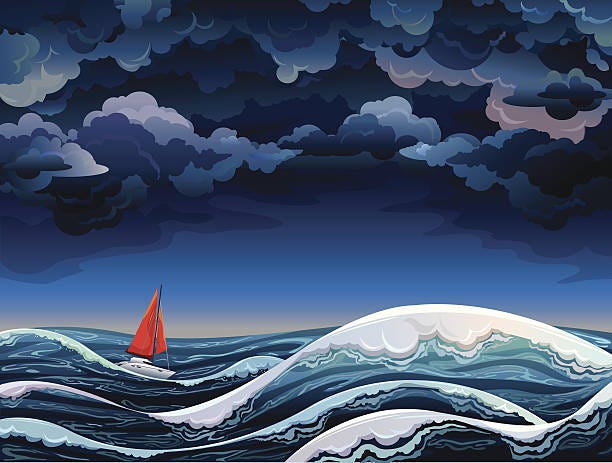
What is the mind, and in what sense could it become ill? For practical purposes, we can consider “mind” as synonymous with psyche, the waters that compose the area of reality’s circle (with clay at the edge and light at the center). Mental illness signifies the emergence of problems in this vast sea, problems such as whirlpools and riptides and cyclones. The waters become troubled and close in on themselves, disrupting the proper arrangement of elements in the human person; they fail to catch the light and refract it outward upon the clay. If the patterns of water become too agitated or narrow or obsessive, the condition is typically called neurosis; whereas the water losing all shape and structure and tension whatsoever, going slack and stagnant—that is called psychosis. In all cases, we may refer to such conditions as psychical maladies, with the term hearkening to the specific location in the circle of reality where the problems dwell. Physical illness afflicts the flesh of clay, psychical maladies trouble the waters of psyche—and what of the light of spirit? Well, as far as we know, the latter can’t fall sick at all, at least not for the bearers of God’s image.
§135. Surreptitious Theology
Modern psychiatry is a materialist cult masquerading as a proper science, and one of the main dogmas of this false religion is that the mind is more or less synonymous with the brain. The brain is a physical organ in the realm of clay, and surely it can become diseased like any other organ, such as the liver or kidneys or stomach. There exists a branch of medicine that addresses the brain at this level, and it is called neurology, the proper scientific focus of which is the nervous system. Dysfunctions of the flesh surely do affect the psyche, and since the brain is essentially the psyche’s interface with material reality, problems in the brain could well produce especially profound negative effects at a higher level. But it is at least as true that the mind (or psyche) has causal effects on the brain as well: experiences of communion and love generate a chemical surge and not the other way around. To reduce consciousness to gray matter, ignore the realm of presence altogether, imagine that atypical behaviors are no more than misfiring neurons—such are psychiatry’s sins, for which it isn’t sorry and does not seek forgiveness. Perhaps it’s long past time for this ship to go under, swallowed by the very waters that it has denied for its entire sordid career.
§136. The Ideal Mind
It is impossible to have a coherent notion of a “sick” mind without first having an archetype of the ideally healthy mind. Such a demand is easy enough for believers, given that our faith is in the perfect man, just as we are called to put on the mind of Christ. But where could the materialist heathens possibly go to find such a paradigm? The best they could do is to appeal to functionality within a given environmental context and conformity to established social norms, without any perspective at all on whether that context or those norms are themselves sick and rotten. Mental illness becomes merely what’s aberrational as a matter of statistics, not that which is objectively disharmonious at the level of ontology. More than that, psychiatrists proceed by evaluating behaviors, which is to say that they make moral judgments—for, indeed, judgments of behavior could be nothing else. We’re dealing with priests in labcoats, then. The claim that someone is “acting crazy” is radically different from the claim that an anomaly has been found in one’s pancreas, with only the latter being properly medical and not moral in nature. We may thus wonder why anyone would listen to the arbitrary assertions of a cult that does not know up from down and would only see mental illness in the prophets and a suicide in the Messiah. An entirely new framework is in order, built from the ground up with a more accurate picture of what a human is.
§137. Strange Metamorphoses
We hear tell of something that once happened in the land of literary Imagination. A plane exploded in the sky, and the two sole survivors fell under a peculiar enchantment, experienced strange metamorphoses. The first man expanded in size, grew hair all over his flesh, developed rougher tastes while losing the more refined ones he’d previously had. His counterpart, in contrast, developed a halo over his head and a very volatile psyche within; he eventually came to believe that he was an archangel and that it was his job to announce the end of the world. These images point toward the bipolar nature of psychical integrity and the two mirrored ways that things could go very wrong. Bestialism is the malady of losing spirit and approaching a merely animal or even vegetal or mineral mode of existence, whereas angelism is the malady of losing flesh and becoming spectrally abstracted away from existence. Bestialism resembles melancholia, and angelism tracks with schizophrenia. In practice, these maladies tend to exist in a bipolar cycle, with angelic abstraction provoking desire for a bestial anchor in the muck, and such an anchor then provoking disgust and a desire for hygienic abstraction—and so on, to the point of dizzy nausea. This libidinal disjunction can only be cured by a final synthesis in the heart that resolves the divide and brings the ride to rest.
§138. An Angel’s Sadness
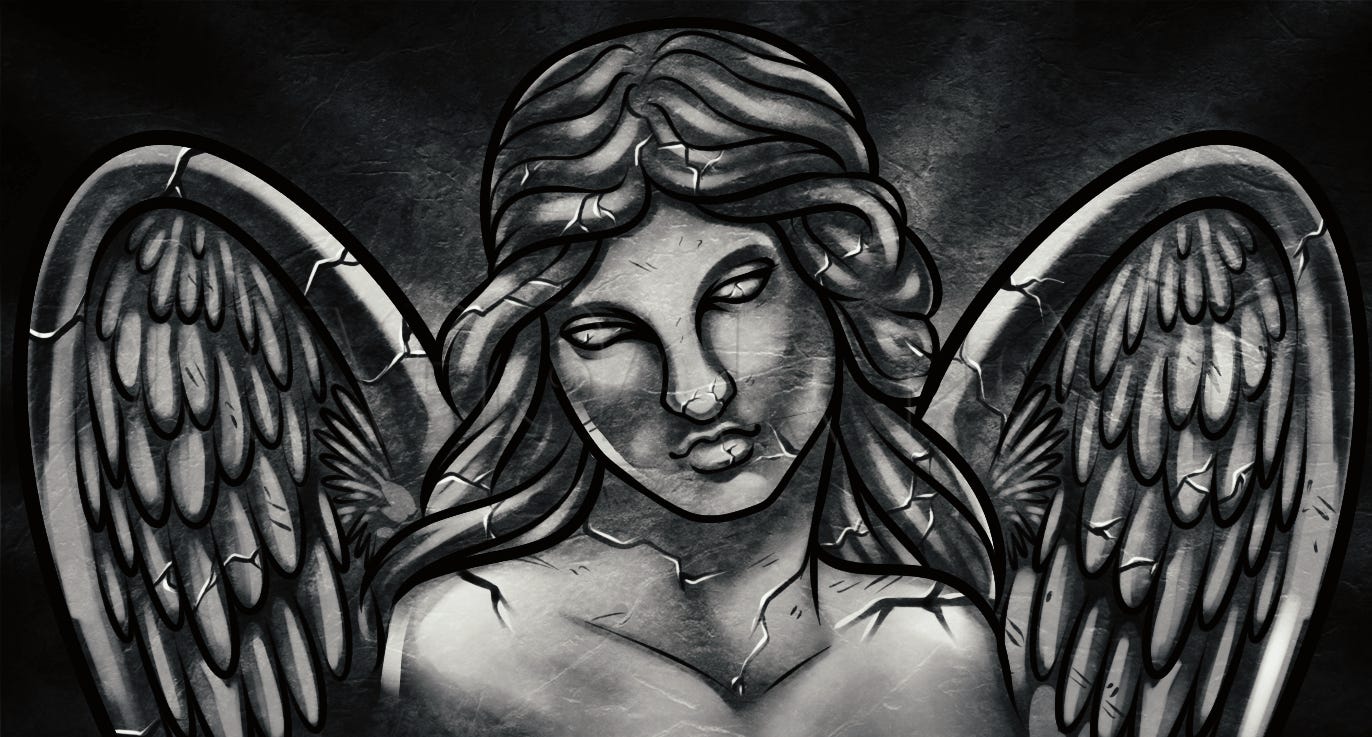
How must the angels feel, having been assigned by God to protect and watch over us humans, and yet being unable to feel or touch or taste the nature of the flesh? Maybe some among them begin to feel as though there is a glass wall between themselves and the Creation, or that they are only able to see life on the far side of a tunnel that they can neither enter nor exit, depending on the perspective. Perhaps some of these angels burn up in resentment and fall into Hell, whereas others burn up in longing and petition God to let them fall into the flesh, become human. In these times where so much of our mortal lives are mediated by flat glowing screens, we suppose that more people than ever are beginning to sense what it must mean to feel the sadness of an angel. We still do have flesh, but it is often far away from us, as it were; our souls hover in spectral space and fail to achieve the incarnation. What would it take to restore the original harmony? We imagine that God Himself was once filled with such thoughts, until the answer came to Him as in a dream, involving a hill called Calvary. And then He took the happy plunge.
§139. Draught of Stiff Stuff
Pure spirit is a dangerous thing, and this is exactly because of the way that it can oscillate between presence and specter, lacking as it does the flesh that can clearly bound the one side from the other. It has trouble securing the synthesis of the Real. And, considering this predicament, our minds drift to the fact that Christ’s signature sacrament involves giving His believers not merely His spirit, and not even just flesh, but His holy blood. The Eucharist is a blast of light encoded in the form of clay—and as such, it halts the oscillation between presence and specter, assists with establishing the final cardiac fusion. The blood of the living God sure is one stiff drink, tuned to the radio frequency of the Real as it is; and if a man ingests it in a poetically sensitive manner, human soul and flesh can get pulled in the direction of harmony with that original Sound, within the dimensional parameters of incarnate presence and not hallucinatory specter. And, as an aside, we may observe that it is a poetic crime for the clergy to hog the holy blood and slam it down their throats all on their lonesome: for there is no communion without the sharing of the cup.
§140. The Sinner’s Prayer
The little word sin can be defined as: any movement of the psyche or flesh that feeds libidinal disjunction, the bifurcation of integrated soul into its angelic and bestial poles. To sin is to lose the presence of the Real, drift into specter. We are left as mere husks of dust, uninhabited by a soul, the latter having gone off into its own exile into the desert of unreality and mirage. And one day, the soul—suddenly startled into an awareness that it has become devoid of all bone and flesh—may seek to begin again from its nostrils, allowing God to slowly build a man again around its breath. Such a soul may come to understand that there is nowhere at all to live but in God’s glorious Creation, the terra firma lifted out of the surrounding spherical Abyss. And we may then pray with the Poet: “Forgive me with these hours and this midnight. Give this thought a master, and this ghost a stone. And do not let the demons boast of your mercy.” The true character of repentance then begins to come into view, and we see that it is far beyond any concern for so-called “morals.” It is, instead, about finally saying yes to the power that can turn a wooden puppet into a real boy, or a stuffed animal into a living rabbit.
"Ḥāfiẓ refers several times to the angels’ inability to understand love and the relationship between man and God. God invites the angels to the spectacle of creation to admire mankind, but when they hear that God is planning to appoint man as a vicegerent on earth (2:30), the angels wonder whether man is going to misuse his power and cause damage. Iblīs, or Satan, started an argument with God, disobeying His command to prostrate himself before mankind. Although ultimately Iblīs was the only angel who disobeyed God’s command, Ḥāfiẓ states that angels generally do not know love: 'O cup-bearer, angels do not know what love is. Ask for a beaker and pour rosewater on Adam’s clay'.
& 'When Your countenance was revealed, it saw that angels had no love, Its honour offended, it became all fire, and struck Adam’s soul. O angel, give praise at the door of love’s wine-house For inside, they are leavening the clay of mankind.'
Using the imperative ‘praise’ in addressing the angels, Ḥāfiẓ highlights the special loving relationship between man and his Creator. Man’s nature is prepared in the wine-house of love to which angels have no access; they should stay outside the door, simply praising God.
We have already seen how Iblīs refused to prostrate himself before Adam. As a lover of God, who had devotedly worshipped Him, Iblīs became jealous when he witnessed the loving relationship between God and mankind. The story of his disobedience as told by the mystics is complicated by the element that, when the angels bowed before Adam, they saw the image of God in him, thus avoiding the idolatry which Iblīs had said would occur. In one of his couplets, Ḥāfiẓ states: When the angels bowed before Adam, their intention was to kiss the ground before you."
- Hafiz and the Religion of Love in Classical Persian Poetry, Leonard Lewisohn
Hmm, what about angels as messengers and not a "species"? As when magical spells in fairys' tails are cast and often bring unforeseen things, it would seem like nothing new is really called up by a spell but rather a moment from outside the poetic veil is brought into the now, a moment which already is populated and surrounded by wills and lives that aren't glimpsed by the unpoetic mind. The prophets are in a sense angels when they are being sent by God, these beings leading an existence of tones and shades of emotions and colours in the shades, couldn't they be sent by God as well, and that would be when a "real angel" is going forth?
I am not trying to be poetic, I just can't express it in a normal rational way. But angels longing for human experience feels off somehow. We are supposedly three dimensional beings, but like Ouspensky shows, we are really multi dimensional, it's just our self imposed limited ways of perceiving that locks us in x, y and z. If other creations' "x, y, z" are not based on your clay circle, they might have their own equivalent to our bodies, and "demonic" as below even the beastialic in St Paul's words would thus make sense for a being e.g. made of tones (as a bad example] giving in to spectral ideas of sexual intercourse in the flesh.